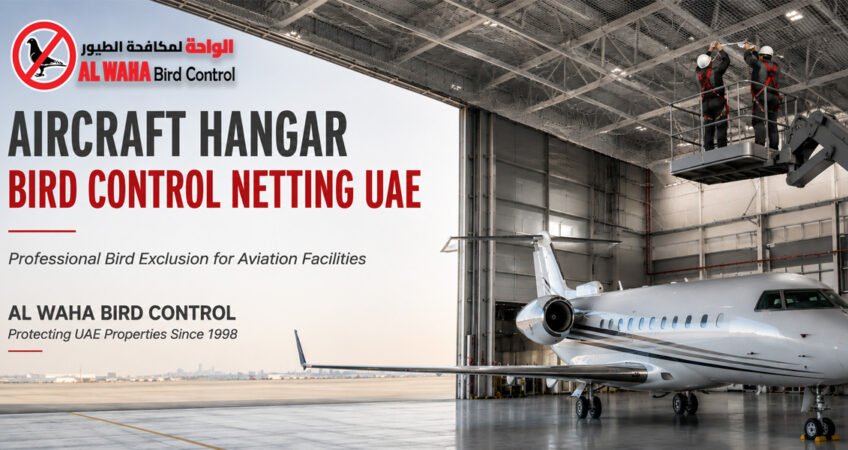
Aircraft Hangar Bird Control Netting UAE is an essential bird exclusion solution for aviation facilities where pigeons and other nuisance birds can enter large hangars, settle on structural beams, roof trusses, lighting systems, service platforms and other elevated areas. Aircraft hangars provide extensive sheltered spaces that can become attractive roosting and nesting locations when birds gain access through large doors, roof openings or unprotected structural areas. Professional bird netting creates a physical barrier that restricts access to these locations without harming birds or interfering with the normal function of the facility.
Bird activity inside an aircraft hangar is more than an appearance or housekeeping concern. Droppings, nesting materials and feathers can contaminate floors, equipment and work areas, while persistent nesting can increase cleaning requirements and create additional maintenance challenges. In facilities containing aircraft, specialist tools, electrical equipment and valuable aviation assets, an effective Hangar Bird Control UAE strategy helps facility managers maintain cleaner, safer and better-controlled working environments.
Professional Aircraft Hangar Bird Netting UAE systems are designed around the individual architecture and operational requirements of each facility. Netting can be configured to protect roof structures, steel beams, ceiling voids and other potential bird-access areas while accommodating lighting, fire-safety systems, ventilation, cranes, doors and maintenance access. When correctly designed and installed, Bird Netting for Aircraft Hangars provides a discreet, humane and long-term method of preventing pigeons and nuisance birds from reaching protected spaces.
AL WAHA Bird Control provides professional Aircraft Hangar Bird Proofing UAE and Aviation Bird Control UAE solutions tailored to commercial, industrial and aviation environments. Every facility requires an appropriate assessment before installation because hangar dimensions, structural design, bird pressure and operational requirements can differ considerably. By combining site inspection, appropriate netting specifications, professional installation and ongoing maintenance, effective Bird Exclusion Systems for Hangars can provide reliable long-term protection while supporting the demanding operational standards of UAE aviation facilities.
Why Aircraft Hangars Are Vulnerable to Bird Activity
Aircraft hangars present a particularly attractive environment for pigeons and other nuisance birds because they combine shelter, height, structural complexity and relatively protected roosting locations. Large hangar doors may remain open for extended periods during aircraft movements and maintenance operations, providing birds with opportunities to enter the building and reach areas that are difficult for personnel to access.
Once inside, birds can take advantage of overhead steelwork, roof trusses, beams, cable trays, lighting structures, ventilation systems and other elevated surfaces. These locations provide protection from direct sunlight, rain, wind and many external disturbances. For this reason, effective Hangar Bird Control UAE requires more than simply removing birds that are already present. The objective should be to identify and restrict access to the structural areas that allow recurring roosting and nesting.
Large Hangar Doors Create Frequent Access Opportunities
Unlike many conventional commercial buildings, aircraft hangars require exceptionally large openings for aircraft movement. Even when a facility has effective door-management procedures, these openings cannot always remain closed during daily operations.
Birds may therefore enter while doors are open and quickly move into the upper structure of the building. Once they discover safe roosting locations, repeated activity can develop unless appropriate Aircraft Hangar Bird Proofing UAE measures are introduced.
Roof Trusses and Structural Beams Provide Ideal Roosting Areas
The extensive overhead structures found inside aviation hangars can create numerous potential landing and nesting locations. Steel beams, horizontal supports, roof frameworks and protected corners may provide birds with elevated positions away from normal human activity.
These areas are also difficult to reach for routine cleaning and inspection. Bird droppings and nesting debris can consequently accumulate beneath established roosting locations, increasing the need for specialist cleaning and long-term bird prevention.
Shelter Encourages Birds to Return
UAE weather conditions can make large enclosed structures particularly attractive to birds. Hangars provide shade from intense sunlight as well as protection from wind, rain and other environmental conditions.
Once pigeons identify a reliable sheltered location, simply frightening or removing them may not provide lasting control. A properly designed Aircraft Hangar Bird Netting UAE system instead focuses on physically preventing access to the protected structure, making the solution less dependent on repeatedly disturbing returning birds.
Complex Hangar Infrastructure Requires a Planned Solution
Aircraft hangars may contain lighting systems, ventilation equipment, fire-protection infrastructure, electrical services, overhead cranes, access platforms and other operational systems. This makes Bird Netting for Aircraft Hangars considerably more specialized than installing netting across a simple open area.
Before installation, the facility should be surveyed to determine bird entry points, established roosting locations, structural fixing options and areas requiring continued maintenance access. The netting layout must then be designed around the building rather than installed as a generic barrier.
Professional Bird Exclusion Systems for Hangars should prevent birds from accessing targeted areas while preserving necessary access to building services and supporting normal facility operations. This site-specific approach is an important part of successful Aviation Bird Control UAE, particularly in large or technically complex aviation facilities.
Risks of Bird Activity Inside Aircraft Hangars
Bird activity inside an aircraft hangar can create operational, hygiene and maintenance concerns that extend far beyond the visible presence of pigeons. In aviation environments where aircraft, specialist equipment, technical workspaces and building services must be maintained to high standards, uncontrolled bird activity can become a recurring facility-management problem. Effective Aircraft Hangar Bird Control Netting UAE therefore forms an important part of a wider preventive maintenance and facility-protection strategy.
Bird Droppings and Surface Contamination
One of the most immediate problems associated with birds inside hangars is the accumulation of droppings beneath regular roosting locations. Aircraft surfaces, floors, equipment, workstations, storage areas and access routes located below beams or roof structures may become exposed to contamination.
Repeated cleaning addresses the consequence but does not prevent birds from returning. Aircraft Hangar Bird Netting UAE provides a more sustainable approach by restricting access to the overhead structures where birds typically roost.
Protection of Aircraft and Valuable Equipment
Aircraft hangars contain high-value assets that should be protected from unnecessary contamination. Birds positioned above aircraft or maintenance areas may deposit droppings, feathers and nesting debris onto surfaces below.
A carefully planned Aircraft Hangar Bird Proofing UAE system can isolate problematic roof structures and overhead spaces, helping reduce bird activity directly above aircraft parking, inspection and maintenance areas.
Hygiene and Workplace Cleanliness
Accumulated bird droppings, feathers and nesting material can negatively affect the cleanliness of a facility. Dried bird waste may also break into fine particles when disturbed, particularly during cleaning or maintenance activities.
Professional Hangar Bird Control UAE should therefore combine prevention with appropriate cleaning practices where existing contamination is present. Heavily affected areas may require bird-waste removal, cleaning and disinfection before or alongside installation of the exclusion system.
Nesting Materials and Building Services
Birds do not restrict themselves to structural beams. Protected areas around equipment, cable routes, platforms, ventilation infrastructure and other building services may also provide potential nesting locations.
Nesting materials can create additional housekeeping and maintenance concerns, particularly where they accumulate close to technical infrastructure. Effective Bird Exclusion Systems for Hangars should therefore be designed after a detailed inspection of both the building structure and the areas where bird activity is already occurring.
Increased Cleaning and Maintenance Requirements
Without a permanent exclusion strategy, facility teams may find themselves repeatedly cleaning the same contaminated areas. This creates an ongoing maintenance cycle without addressing the source of the problem.
Installing Bird Netting for Aircraft Hangars can substantially reduce access to established roosting locations. Once birds are excluded from these areas, cleaning teams can concentrate on maintaining the facility rather than continually responding to recurring contamination.
Maintaining Professional Aviation Facility Standards
Aircraft hangars are highly specialized environments, and cleanliness, organization and preventive maintenance contribute to overall facility standards. Visible bird activity, nesting material and accumulated droppings are inconsistent with the controlled environment expected within professionally managed aviation facilities.
For this reason, Aviation Bird Control UAE should be approached as a preventive facility-management measure rather than simply a response after a major infestation develops. Early identification of bird activity followed by appropriate physical exclusion can help prevent a small problem from becoming a persistent one.
Why Bird Netting Is an Effective Solution for Aircraft Hangars?
Among the different bird deterrent and exclusion methods available, professional bird netting is particularly well suited to large aircraft hangars because it creates a physical barrier between birds and the areas they are attempting to access. A properly designed Aircraft Hangar Bird Control Netting UAE system does not rely on repeatedly frightening birds away. Instead, it prevents them from reaching protected roof structures, beams and other established roosting locations.
For large aviation facilities, this physical-exclusion approach can provide an effective long-term solution while remaining humane. The objective is not to trap or harm birds, but to prevent them from entering designated areas and encourage them to move elsewhere.
Creates a Physical Bird Exclusion Barrier
Bird netting works differently from visual or temporary deterrents. Once the netting is correctly positioned and tensioned, pigeons and other targeted birds cannot access the protected space behind it.
This makes Bird Netting for Aircraft Hangars particularly useful for protecting extensive overhead structures where numerous beams, trusses and horizontal surfaces would otherwise provide potential roosting locations.
Suitable for Large and Complex Areas
Aircraft hangars can have substantial ceiling heights and very large roof spans. Treating every individual beam or landing surface separately may not always be practical.
A professionally engineered Aircraft Hangar Bird Netting UAE system can instead create defined exclusion zones beneath or around groups of structural elements. This allows large areas of potentially attractive bird habitat to be protected through a coordinated system.
Humane Bird Prevention
Professional bird netting is fundamentally an exclusion method. Birds are prevented from reaching the protected area without requiring harmful control measures.
However, correct installation is essential. Before an exclusion zone is permanently closed, technicians must ensure that no birds are trapped behind the netting and that active nesting situations are handled appropriately. The system should also be routinely inspected so that damaged or displaced sections do not create potential entry or entanglement points.
This makes properly installed netting an important option within a responsible Aviation Bird Control UAE strategy.
Can Be Adapted Around Hangar Infrastructure
Hangar ceilings rarely consist of simple uninterrupted surfaces. Lighting, ventilation, fire-protection equipment, electrical services, access platforms and other infrastructure may all pass through areas requiring bird protection.
Professional Bird Exclusion Systems for Hangars can be designed around these obstacles using suitable perimeter supports, fixings, tensioning systems and access arrangements. Where equipment requires periodic servicing, appropriately positioned access sections can be incorporated into the installation.
Helps Reduce Recurring Cleaning Requirements
Where birds regularly roost above aircraft parking or maintenance areas, cleaning alone becomes a repetitive expense. Removing droppings addresses existing contamination but does not stop birds from returning to the same structural locations.
Effective Aircraft Hangar Bird Proofing UAE addresses the source of the problem by restricting access to those areas. Once established roosting locations are successfully excluded, the frequency of bird-related contamination can be significantly reduced.
Designed for Long-Term Protection
A high-quality netting installation should be treated as part of the building’s protective infrastructure rather than as a temporary bird deterrent. Correct material selection, secure anchoring, appropriate tension and periodic inspection all contribute to the service life and effectiveness of the system.
For UAE aviation facilities, environmental conditions and the characteristics of the building should also be considered when selecting materials and fixing methods. Professional Hangar Bird Control UAE therefore begins with a detailed site assessment rather than choosing a netting system based only on the dimensions of the area.
When correctly specified and professionally installed, bird netting provides aircraft hangar operators with a discreet, humane and durable method of controlling access to some of the most difficult bird-prone areas within the facility.
Choosing the Right Bird Netting System for Aircraft Hangars
Selecting the correct netting system is a critical part of successful Aircraft Hangar Bird Control Netting UAE. Aircraft hangars vary considerably in size, structural design, ceiling height, bird pressure and operational requirements, which means there is no single netting specification suitable for every facility. The system should be selected only after evaluating the target bird species, protected area, supporting structure, environmental conditions and required access to building services.
Professional Bird Netting for Aircraft Hangars involves considerably more than choosing a piece of mesh and attaching it beneath the roof. Netting material, mesh size, perimeter support, fixings, tensioning and access arrangements must work together as one complete bird exclusion system.
Selecting the Appropriate Mesh Size
Mesh size should primarily be selected according to the bird species that needs to be excluded. Pigeons are among the most common nuisance birds associated with commercial and industrial buildings, but smaller bird species may require a finer mesh.
Using an unnecessarily small mesh can add material and installation requirements without providing a meaningful advantage, while mesh that is too large may allow the targeted species to pass through.
A professional Aircraft Hangar Bird Netting UAE survey should therefore identify the bird species and existing activity before the netting specification is finalized.
High-Quality Netting Materials
Netting used within large commercial and aviation facilities should offer an appropriate combination of strength, low weight and durability. Depending on the application, professional bird-control systems commonly use purpose-manufactured polyethylene or other suitable bird-netting materials designed for long-term exclusion applications.
Material quality is particularly important across large spans because deterioration or failure in even a relatively small section can potentially provide birds with a route back into the protected area.
UV and Environmental Resistance
Although some hangar netting is installed predominantly indoors, sections close to hangar doors, external openings or partially exposed structures may experience significant UAE sunlight and environmental exposure.
For this reason, Aircraft Hangar Bird Proofing UAE should take into account UV resistance, temperature conditions, moisture exposure and the location of each protected area. Material specification should be based on actual site conditions rather than assuming every part of a hangar has the same environment.
Perimeter Support and Fixing Systems
The effectiveness of a bird netting installation depends heavily on its supporting system. Large netted areas typically require secure perimeter support and suitable fixing points capable of maintaining the intended position and tension of the net.
Fixing methods must be selected according to the building structure and substrate. Steel structures, concrete surfaces and other construction materials may require different anchoring approaches.
Professional Bird Exclusion Systems for Hangars should therefore be designed around the existing structure rather than forcing a standard fixing method onto every building.
Correct Net Tension
Netting should be installed with appropriate and consistent tension. Loose or poorly supported sections can reduce the appearance and effectiveness of the installation and may create areas where birds attempt to land or gain access.
At the same time, excessive or incorrectly distributed loading should be avoided. Large-span Hangar Bird Control UAE installations require careful positioning of support lines and fixing points so that the completed system remains stable and properly configured.
Access for Maintenance and Building Services
One of the most important considerations inside an aircraft hangar is continued access to infrastructure located above the netting. Lighting, ventilation, electrical systems, fire-safety equipment and other services may require inspection or maintenance after the bird-control system has been installed.
Where access is required, professionally designed openings or releasable sections can be incorporated into the netting layout. This allows authorized maintenance personnel to reach protected infrastructure without unnecessarily dismantling large areas of the system.
Visibility and Appearance
Bird netting installed correctly at significant ceiling heights can be relatively unobtrusive when viewed from the hangar floor. Appropriate net colour, mesh dimensions and installation geometry can help the system blend with the surrounding roof structure.
For aviation facilities where appearance and organization are important, a carefully planned Aviation Bird Control UAE installation should provide effective exclusion without creating an unnecessarily intrusive visual element.
Ultimately, the correct netting system is determined by the conditions of the individual hangar. A professional site survey allows the installer to evaluate bird pressure, structural characteristics, operational requirements and maintenance access before recommending the most appropriate materials and installation configuration. This site-specific approach is fundamental to achieving reliable, long-term bird exclusion.
Aircraft Hangar Bird Netting Installation Process
Professional installation is one of the most important factors determining the effectiveness of Aircraft Hangar Bird Control Netting UAE. Large aircraft hangars can contain extensive roof structures, high ceilings, steel trusses, lighting systems, ventilation equipment and other services that make bird netting installation considerably more complex than standard commercial applications.
For this reason, installation should begin with a detailed site assessment and a planned exclusion strategy. The objective is not simply to cover visible bird-roosting locations, but to create a complete barrier that prevents birds from finding alternative routes into the protected structure.
1. Detailed Hangar Site Survey
The first stage of professional Aircraft Hangar Bird Netting UAE installation is a comprehensive site inspection. Technicians assess the dimensions and configuration of the hangar, existing bird activity, entry routes, nesting and roosting locations, structural fixing opportunities and areas requiring protection.
The survey should also identify operational infrastructure that may affect the netting layout, including:
- Roof trusses and structural steelwork
- Lighting installations
- Ventilation and HVAC systems
- Fire detection and suppression equipment
- Electrical and communication services
- Overhead cranes or moving equipment
- Maintenance platforms and access routes
- Hangar doors and aircraft movement areas
This information allows the Bird Exclusion System for Hangars to be designed around the actual facility rather than relying on a standard installation configuration.
2. Identification of Bird Entry and Roosting Areas
Understanding how birds are using the building is essential. Technicians look for droppings, feathers, nesting materials and repeated activity around beams, ledges, roof structures and other sheltered areas.
Entry points should also be identified. Large hangar doors may be the most obvious route, but birds can sometimes exploit other openings or gaps within the structure.
Effective Hangar Bird Control UAE focuses on both the locations birds currently occupy and the areas they may attempt to use after their preferred roosting sites have been excluded.
3. Designing the Netting Layout
Once the survey is complete, the protected zones can be planned. Depending on the hangar configuration, netting may be installed beneath roof structures, around individual sections or across larger areas containing multiple potential roosting locations.
The design should minimize unnecessary obstruction while providing complete exclusion from the targeted space.
Special consideration must be given to equipment requiring future maintenance. Access points or releasable netting sections can be incorporated where necessary so technicians can reach lighting, mechanical or electrical infrastructure without dismantling the entire installation.
4. Installation of Perimeter Supports and Fixings
A secure supporting framework is essential for maintaining the netting in its intended position. Suitable anchors and perimeter support systems are selected according to the structural material and installation environment.
For large-span Bird Netting for Aircraft Hangars, fixing points must be carefully positioned so that loads are appropriately distributed and the completed netting remains stable.
Installation teams may need specialized access equipment such as mobile elevated work platforms or other approved systems to safely reach high-level structural areas.
5. Positioning and Tensioning the Bird Net
After the supporting system has been established, the netting is positioned across the designated exclusion area and secured to the perimeter.
Correct tension is important. The finished net should remain neat and stable without excessive sagging while avoiding inappropriate loading on the supporting structure.
Edges, intersections, penetrations and transitions around building services require particular attention. Even a relatively small unprotected opening may allow persistent birds to regain access behind the system.
6. Creating Maintenance Access Where Required
Aircraft hangars contain infrastructure that may need regular inspection or servicing. A well-designed Aircraft Hangar Bird Proofing UAE installation should therefore consider maintenance requirements from the beginning.
Where necessary, suitable access arrangements can be incorporated into the system. These allow authorized personnel to enter protected areas and then properly close the netting afterward, helping preserve the integrity of the exclusion barrier.
7. Final Inspection of the Completed System
Once installation is complete, the entire protected area should be inspected. Technicians check perimeter connections, net tension, penetrations, access sections and potential gaps.
It is also important to confirm that no birds have been accidentally enclosed within the protected space before the installation is considered complete.
This final inspection is a crucial stage of responsible Aviation Bird Control UAE, because successful bird netting depends on maintaining a continuous exclusion barrier.
8. Ongoing Inspection and Maintenance
Bird netting should not simply be installed and forgotten. Periodic inspection helps identify accidental damage, displaced sections, opened maintenance access points or changes to the building infrastructure that could compromise the system.
Maintenance is particularly important if contractors subsequently work above or around the netting. Any section temporarily opened to access equipment should be correctly reinstated afterward.
Through professional design, installation and ongoing inspection, Aircraft Hangar Bird Control Netting UAE can provide a durable physical barrier that protects large and technically complex aviation facilities from recurring bird access.
Safety and Operational Considerations for Bird Netting in Aircraft Hangars
Installing Aircraft Hangar Bird Control Netting UAE requires careful coordination between the bird control contractor, facility management team and relevant site personnel. Aircraft hangars are specialized working environments where technicians may need to operate at significant heights and around aircraft, maintenance equipment, electrical services, fire-protection infrastructure and ongoing aviation activities.
A professional installation plan should therefore consider not only bird exclusion performance but also safe access, protection of assets and minimal disruption to normal facility operations.
Working Safely at Height
Much of an aircraft hangar’s bird activity occurs around high-level beams, roof trusses and structural supports. Installing netting in these areas may require mobile elevated work platforms, scaffolding or other appropriate access systems depending on the building configuration.
Before work begins, access routes, working heights, structural obstacles and suitable equipment should be assessed. Installation personnel should follow applicable site safety procedures and use appropriate personal protective equipment and fall-protection measures for the work being performed.
Professional Bird Netting Installation UAE for large aviation structures should always be planned around the actual access and safety conditions of the facility.
Protecting Aircraft and Aviation Assets
Aircraft, tools, machinery and specialist equipment located inside the hangar must be considered during installation planning. Where practical, the work zone should be coordinated so that installation activity does not take place directly above exposed aircraft or sensitive equipment.
Tools, fixings and installation materials should be appropriately managed when technicians are working at height. Controlled work areas can also help separate bird netting activities from other personnel and facility operations.
This level of planning is particularly important when Bird Netting for Aircraft Hangars is being installed within an operational aviation environment.
Coordinating Installation Around Hangar Operations
Completely closing a large aviation facility may not always be practical. Depending on site requirements, Hangar Bird Control UAE installation can be divided into planned sections so that work progresses systematically through the facility.
Installation schedules may be coordinated around aircraft movements, maintenance activities and periods of reduced operational demand. This phased approach can help minimize disruption while allowing technicians sufficient access to complete each exclusion zone correctly.
Fire-Safety and Building Systems
Aircraft hangars may contain extensive fire detection and suppression infrastructure. Bird netting must be planned so that it does not improperly interfere with sprinklers, detectors, alarms, smoke-control equipment or other life-safety systems.
The same principle applies to lighting, ventilation, electrical installations and other essential building services.
Before implementing Aircraft Hangar Bird Proofing UAE, the proposed netting layout should therefore be reviewed against the infrastructure present within the protected area. Where necessary, relevant facility or specialist personnel should be consulted before installation proceeds.
Overhead Cranes and Moving Equipment
Some aircraft maintenance hangars contain overhead cranes, lifting systems or other equipment operating within the roof space. These moving systems require particular attention when designing a bird exclusion barrier.
Netting should never be positioned where it could interfere with the normal travel or operating envelope of moving equipment. Instead, the exclusion layout must account for these systems from the design stage.
This is one reason professional Bird Exclusion Systems for Hangars require a detailed site survey rather than a generic netting configuration.
Maintaining Emergency and Maintenance Access
Bird netting should not obstruct designated emergency routes or prevent authorized personnel from accessing equipment that requires inspection and servicing.
Where access through a protected area is necessary, suitable netting access arrangements can be incorporated into the system. Facility teams should also understand how these sections are opened and, importantly, how they must be properly secured again after maintenance.
Preventing Birds from Becoming Trapped
One of the most important considerations during any exclusion project is ensuring that birds are not accidentally enclosed behind newly installed netting.
Before an area is completely sealed, technicians should inspect the protected zone and confirm that birds can safely leave. Installation sequencing may need to be adjusted where active bird activity is present.
Responsible Aviation Bird Control UAE is based on exclusion and prevention. The objective is to deny access to unwanted roosting and nesting locations without unnecessarily harming birds.
Site-Specific Planning Is Essential
Every aviation facility operates differently. Hangar size, aircraft type, maintenance schedules, roof configuration, access restrictions and internal infrastructure can all influence how the bird netting project should be undertaken.
For this reason, professional Aircraft Hangar Bird Control Netting UAE should always begin with coordination between the facility and the bird control contractor. A properly planned installation can achieve effective long-term bird exclusion while respecting the safety, operational and maintenance requirements of a demanding aviation environment.
Protect Your Aviation Facility with Professional Aircraft Hangar Bird Control Netting UAE
Aircraft Hangar Bird Control Netting UAE provides aviation facility managers with a practical, humane and long-term method of preventing pigeons and nuisance birds from accessing roof structures, beams, trusses and other difficult-to-reach areas inside aircraft hangars. By creating a properly designed physical exclusion barrier, bird netting addresses the source of recurring roosting and nesting rather than relying solely on repeated cleaning or temporary deterrent measures.
Successful Aircraft Hangar Bird Netting UAE requires more than installing mesh across an open space. Bird species, hangar dimensions, structural configuration, fixing locations, maintenance access, building services, operational requirements and safety considerations must all be evaluated before installation. A professionally planned Aircraft Hangar Bird Proofing UAE system can help reduce bird-related contamination, protect valuable aviation environments and support cleaner, better-maintained facilities over the long term.
AL WAHA Bird Control has practical experience delivering bird control solutions for large and technically demanding UAE facilities. Our work includes the National Center of Meteorology project, where bird protection requirements within a major hangar environment demonstrate the importance of site-specific planning, professional access and properly designed exclusion systems. This practical experience allows our team to approach Aviation Bird Control UAE projects with an understanding of the challenges presented by large-span structures and high-level bird activity.
Every aircraft hangar presents different conditions, which is why AL WAHA begins with an assessment of the facility before recommending the appropriate Bird Netting for Aircraft Hangars. Our team can identify bird activity, evaluate potential entry and roosting areas and develop Bird Exclusion Systems for Hangars suited to the building’s structure and operational requirements.
If pigeons or nuisance birds are entering your aircraft hangar, airport maintenance facility or aviation building, contact AL WAHA Bird Control for a professional site assessment. We provide Hangar Bird Control UAE, bird netting, bird proofing and specialized bird exclusion solutions for aviation, commercial and industrial facilities throughout the United Arab Emirates.
Request a Professional Aircraft Hangar Bird Control Assessment
Prevent recurring bird activity before contamination and maintenance requirements become more difficult to manage. Contact AL WAHA Bird Control today to arrange a site survey and discuss an Aircraft Hangar Bird Control Netting UAE solution designed specifically for your facility.
Conclusion
Effective Aircraft Hangar Bird Control Netting UAE requires a carefully planned approach that considers the size and structure of the hangar, existing bird activity, operational requirements and the infrastructure located within the protected areas. When professionally designed and installed, bird netting provides a physical barrier that prevents pigeons and nuisance birds from accessing roof trusses, beams and other established roosting and nesting locations.
For aviation facilities, prevention is particularly important. Allowing bird activity to continue can result in recurring droppings, nesting debris, additional cleaning requirements and contamination of areas containing valuable aircraft and specialist equipment. Professional Aircraft Hangar Bird Netting UAE and Aircraft Hangar Bird Proofing UAE address the problem at its source by restricting access rather than repeatedly responding to the consequences.
A successful Aviation Bird Control UAE strategy should therefore combine professional site assessment, appropriate netting specifications, safe installation, cleaning where required and periodic inspection of the completed system. With the correct Bird Exclusion Systems for Hangars, aviation facilities can maintain cleaner, better-protected and more professionally managed environments over the long term.
AL WAHA Bird Control provides specialized Hangar Bird Control UAE solutions for aviation, commercial and industrial facilities throughout the United Arab Emirates. With experience in complex large-scale facilities, our team can assess your aircraft hangar and recommend a bird exclusion solution appropriate to its structure and operational requirements.
Contact AL WAHA Bird Control to arrange a professional site survey and discover the most suitable bird netting and bird proofing solution for your aircraft hangar.
Bird Management Best Practices
Commercial property owners should follow internationally recognized bird management and hygiene practices. Useful industry resources include: